
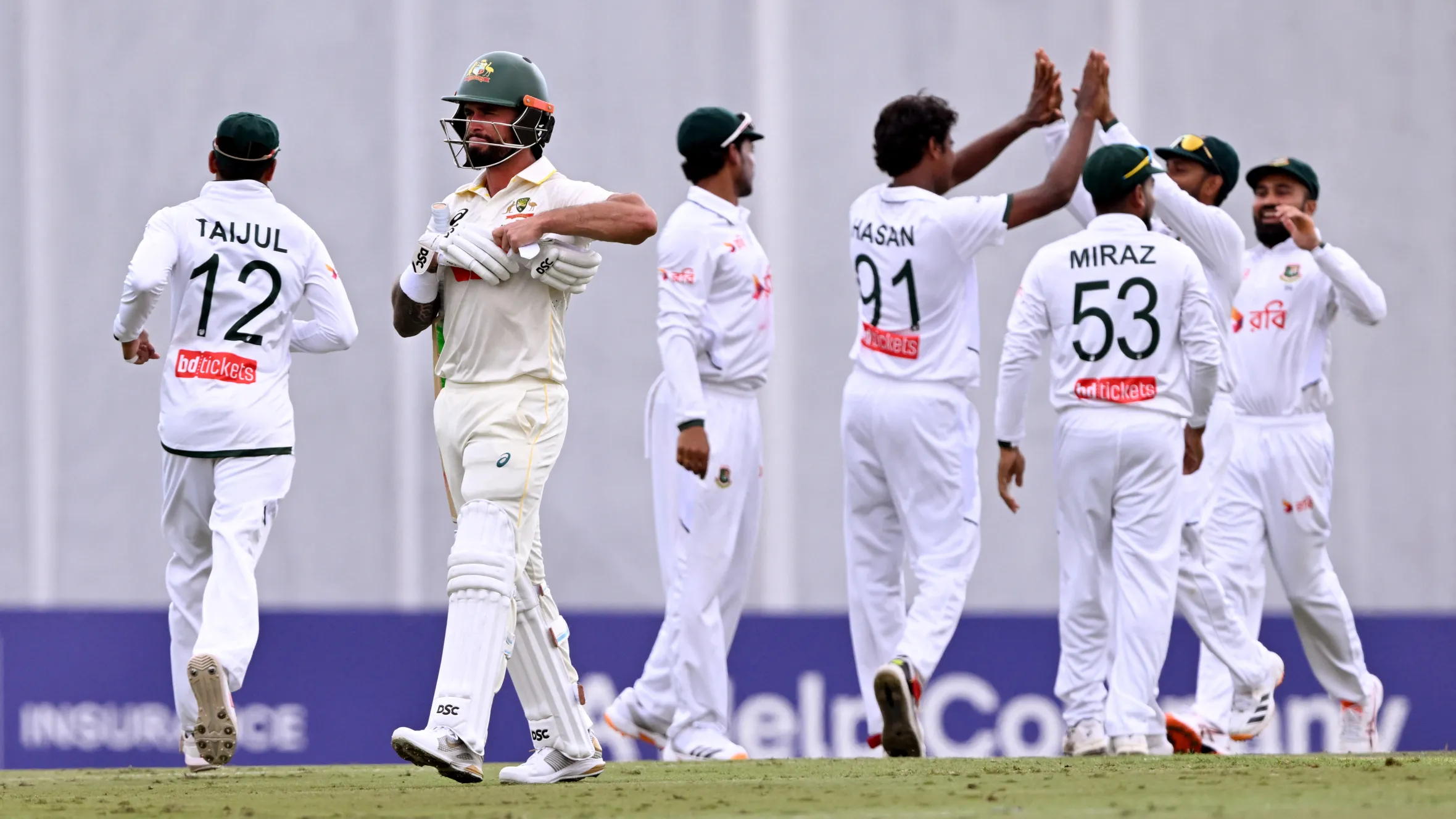
Ponting: Australia Batting Not Up to Test Standard
Ricky Ponting was deeply concerned about Australia’s strategy and performance during the game. He underlined the decision to bat first after winning the toss, arguing that the circumstances benefited the home team’s seamers.
Australia was dismissed for 198 in the first innings of the first Test match against Bangladesh at Darwin’s Marrara Stadium on August 13-17, 2026.
Hasan Mahmud took 6 for 55 as the batting lineup battled against Bangladesh’s attack, with Steve Smith leading the way with 71. Ricky Ponting, a former Australian captain, strongly blasted the performance.
Ponting was deeply concerned about Australia’s strategy and performance during the game. He underlined the decision to bat first after winning the toss, arguing that the circumstances benefited the home team’s seamers.
According to the former captain, Australia missed an opportunity to improve their squad depth during the two Test matches against Bangladesh due to early season rustiness.
They haven’t played in a long time, but that doesn’t explain some of the technical faults and weaknesses we saw, particularly in the top tier. I was shocked Australia elected to bat, especially when Bangladesh scored 54 in the warm-up game. “The Australian seamers on that wicket yesterday morning would have been virtually unplayable,” Ponting remarked on SEN’s Fireball.
Why Ponting criticised Australia’s toss decision.
Ponting commented that, given the opposition’s recent performance, Australia’s total fell short of expectations. He highlighted that instead of relying solely on the present squad, the team should consider adding younger players to the Test system.
The former captain emphasised the importance of managing the team’s age profile and preparing for the future. “When you win the toss and decide to bat, everyone expects a few more than 190 against an attack like that.”
I still believe they squandered an opportunity to showcase some of Australia’s younger potential in these recent games. Go with your gut and pick on skill because what we have in the present squad today, and has been for a number of years, does not look up to Test cricket standards,” Ponting remarked.
Ponting had earlier urged in these two Tests against Bangladesh that younger players such as Ollie Peake and Campbell Kellaway should be developed. During the upcoming tour of South Africa, he expressed concerns about starting young players in more challenging situations.
Australia’s age distribution and future
In preparation for a difficult period, Australia’s squad composition indicates a significant age challenge. Cameron Green is the team’s youngest member, and everyone else is over thirty.
Yesterday’s squad is the oldest since 1928. Until the World Test Championship ends, the team will play 21 Tests, including away games in South Africa and India, as well as home matches against New Zealand.
“Yesterday’s team was the oldest since 1928, so you’re talking about an ageing team and a reconstruction. That is the situation. Cameron Green is the team’s youngest member, and everyone else is at least 30 years old.
There are 21 Tests remaining in the World Test Championship. “They’re in New Zealand, South Africa, and India,” Ponting explained.
Ponting predicted that Australia would have to rotate their lineup throughout this demanding schedule. He suggested that in order to reduce tiredness and build depth throughout the Test format, the squad organically incorporate fresh players.
“Inevitably, they’ll go thru 16-18 guys in this next short stretch. So I believe it will develop organically, with guys going in and out to try and manage them till the finish,” Ponting added.
Bangladesh’s lead in the first Test has already exceeded 100 runs, putting Australia in a tight position. To win this Test match, the home team would have to bat exceptionally well.
